Views: 0 Author: Site Editor Publish Time: 2026-09-06 Origin: Site
Electrical engineers, facility managers, and developers often face a critical dilemma. You must finalize outdoor power distribution systems carefully. Selecting the right equipment dictates long-term project success. Both primary solutions effectively step down voltage for end-user consumption. However, they differ fundamentally in integration levels, physical footprints, and internal protective capabilities. Making the wrong choice easily leads to strict footprint compliance issues. It can also result in compromised site safety or severe operational bottlenecks. We designed this objective, engineering-focused comparison to simplify your decision. Our goal is to help specifiers seamlessly align equipment capabilities. We match these capabilities against specific project load demands and site realities. You will understand exactly which architecture best fits your unique environment. We will explore core architectures, load thresholds, and physical installation requirements. This ensures your final design meets all utility standards perfectly.
Integration: A pad-mounted transformer is primarily a standalone step-down unit, while a compact substation integrates the transformer, medium-voltage (MV) switchgear, and low-voltage (LV) distribution into a single engineered housing.
Cost vs. Capability: Pad-mounted units offer lower initial Capex and a smaller footprint for standard loads. Compact substations provide advanced protection, switching, and metering for complex or high-capacity sites (e.g., approaching 5 MVA).
Compliance: Urban planning, local utility regulations, and site safety clearances will often dictate the final choice regardless of baseline budget.
You can define this unit as a localized outdoor distribution node. It sits inside a tamper-resistant, grounded metal cabinet. A pad-mounted transformer excels in standalone applications. You typically use it to step down utility voltage directly. It serves single commercial buildings, residential subdivisions, or localized industrial outbuildings.
The primary components remain straightforward. You will find a core and coil assembly inside. Mineral oil or natural dielectric fluid typically immerses these active parts. The design includes basic primary fusing, such as bayonet-style fuses. It also features basic secondary connections. It does not contain extensive breaker panels or advanced metering infrastructure. You must house those secondary components elsewhere. Often, you place them inside the main building electrical room.
Best Practice: Always verify your utility company standardizes on dead-front construction. Dead-front designs hide all energized primary parts behind insulated connectors. This provides a crucial layer of operator safety.
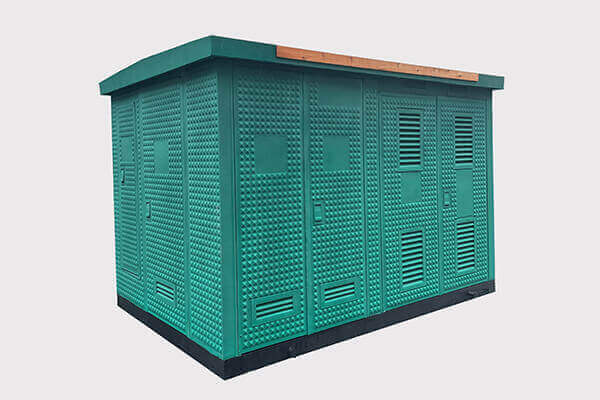
A compact substation represents a fully integrated, factory-assembled solution. It comprises three distinct, internal compartments. First, it houses medium-voltage (MV) switchgear. Second, it contains the main transformer. This transformer can be oil-filled or a dry-type unit. Finally, it includes a low-voltage (LV) switchboard or distribution panel.
This unit acts as a highly localized control node. It isolates faults seamlessly. It offers advanced switching capabilities. You can integrate digital metering directly into the enclosure. The primary advantage is consolidation. You eliminate the need for separate upstream MV enclosures. You also remove the need for downstream LV distribution panels outdoors. The factory engineers everything to work together. This guarantees tested short-circuit withstand ratings across the entire assembly.
Matching equipment to actual power demands is critical. You must also account for future load scalability. Every facility requires a tailored approach. Under-engineering restricts your operational growth. Over-engineering ties up valuable capital unnecessarily.
Standard pad-mounted limits suit straightforward loads perfectly. Manufacturers do build high-capacity single units. However, pushing a single pad-mount toward the 5 MVA threshold introduces severe complications. You must manage massive secondary cabling bundles. Symmetrical fault current ratings escalate rapidly. Thermal management becomes highly complex. Pushing extreme currents through a standalone outdoor distribution transformer often requires parallel secondary feeds. Terminating multiple heavy-gauge cables in a standard cabinet is notoriously difficult.
Integrated solutions offer distinct advantages for heavy capacities. They suit heavy industrial loads, multi-tenant facilities, and renewable energy grids. Integrated MV switchgear allows for much safer handling of high fault currents. You can utilize a Ring Main Unit (RMU) for primary switching. On the secondary side, load division becomes effortless. The internal LV compartment houses multiple outgoing circuit breakers. You distribute power directly to different facility wings. You avoid routing massive, singular bus ducts into your building. This modular power division enhances overall system reliability.
Common Mistake: Failing to calculate future electric vehicle (EV) charging loads. Always leave a 20-30% capacity buffer on your distribution nodes. Adding a completely new unit later disrupts site operations significantly.
Space evaluation plays a massive role in equipment selection. Urban setbacks and discrete landscaping rules strictly govern outdoor installations. You must carefully analyze your available physical footprint.
Standard pad-mounted units are generally much more compact. They boast a minimal physical profile. They easily hide behind standard landscaping screens. They fit snugly into tight urban setbacks. Their smaller size makes them visually unobtrusive.
Installation realities differ sharply between the two technologies. A standard unit requires a relatively simple concrete pad. You need basic trenching for underground primary and secondary feeds. You must strictly adhere to clearance radii. Fire codes mandate specific distances from building doors, windows, and ventilation intakes.
Integrated substations require a significantly larger foundation. The concrete pad is often heavily reinforced. It must support the combined weight of three distinct compartments. However, you must view this holistically. The integrated MV and LV switching eliminates separate electrical rooms indoors. It also removes the need for secondary outdoor switchgear pads. This consolidation often saves overall site space. You reclaim premium indoor square footage for primary business operations.
Implementation risks exist for both systems. You must account for local utility vehicular access. Crane trucks need clear turning radii for future replacement operations. You also must navigate oil-spill containment regulations. Local codes may require specialized retention pits beneath the concrete foundation.
Table 1: Physical and Installation Comparison
Feature | Pad-Mounted Unit | Integrated Substation |
|---|---|---|
Physical Footprint | Compact, low profile | Large, elongated housing |
Foundation Requirements | Standard concrete pad | Heavily reinforced pad, possible cable basement |
Clearance Radii | Strict proximity rules to buildings | Flexible, often acts as a standalone node |
Underground Feeds | Simple direct trenching | Complex trenching for multiple LV outgoing circuits |
Indoor Space Saved | Minimal (requires indoor LV panels) | Maximum (LV distribution handled outdoors) |
Enclosure security prevents unauthorized public access. Both solutions feature tamper-proof outdoor designs. They utilize heavy-gauge steel. They feature hidden hinges and penta-head locking mechanisms. They protect the public from lethal voltage effectively.
Integrated solutions offer uniquely isolated compartments. This compartmentalization vastly improves operator safety. Maintenance personnel can open and access the LV panel safely. They remain completely separated from the MV section. They never directly expose themselves to the main transformer tank. This isolation streamlines routine maintenance tasks. It reduces required personal protective equipment (PPE) levels for simple LV breaker resets.
Arc Flash Containment: Integrated housings typically offer superior internal fault mitigation. The metallic partitions direct explosive arc energy away from operators. Specialized roof flaps or rear vents release pressure safely.
Switching Safety: You can incorporate motorized MV switches. Operators can perform primary switching remotely. This eliminates manual interaction during live load transfers.
Fault Isolation: Dedicated protection relays monitor system health continuously. They trip individual breakers instantly upon detecting phase imbalances or short circuits.
Environmental compliance deeply influences urban planning. Fluid-filled units always carry a theoretical leak risk. You must adhere to strict Environmental Protection Agency (EPA) guidelines. Urban centers often restrict large volumes of mineral oil near waterways.
Integrated units solve this elegantly. They can utilize cast-resin dry-type transformers internally. This completely eliminates oil-spill risks. You avoid building expensive concrete containment bunds. Dry-type integration works perfectly in environmentally sensitive areas. It also suits high-density urban placements seamlessly. You simply ventilate the housing properly to manage heat dissipation.
You must adopt a structured evaluation framework. Deciding between a pad mounted transformer vs compact substation requires logical elimination. We recommend using a clear decision tree. This aligns your specific project parameters with the correct equipment type.
Evaluate the Load Type: Is your load straightforward? Is it typically under 2.5 to 3 MVA? If yes, lean toward a standard pad-mount. Do you manage a heavy industrial site or a solar farm? Heavy loads favor integrated substations.
Locate the Downstream Protection: Are you placing the main LV distribution switchboard inside the building? If yes, a standard unit suffices. Do you need to save indoor space? Keep all primary LV distribution outdoors using an integrated unit.
Assess MV Switching Needs: Does your local utility handle all upstream switching? A basic step-down unit works fine. Do you require complex ring-main switching? An integrated solution provides the necessary RMU internally.
Check Environmental Rules: Are you near a protected watershed? Do local codes ban oil-filled equipment? Choose an integrated unit housing a dry-type core.
Your next-step actions must include auditing local utility standards. Utilities frequently mandate one specific technology over the other. You must also calculate exact load profiles. Review your single-line diagrams carefully. Finally, evaluate your site foundation constraints. A geotechnical survey confirms if your soil supports heavily reinforced concrete pads.
Choosing the optimal equipment secures your facility infrastructure. It guarantees continuous operational uptime. It simplifies future maintenance significantly. You protect your personnel from hazardous electrical environments.
The choice between these two distribution methods is rarely a simple preference. It is dictated by load density, safety requirements, and site infrastructure. Standard units excel in straightforward, low-footprint applications. Integrated solutions dominate complex, high-capacity industrial networks. They offer unmatched safety through physical compartmentalization.
Remember this crucial credibility anchor: over-engineering leads to wasted capital. Conversely, under-engineering leads to immediate safety hazards and severe operational bottlenecks. You must strike the perfect balance based on your specific load data. Evaluate your environmental constraints thoroughly.
We prompt you to consult with a licensed electrical design engineer early. Reach out to your technical sales team immediately. Provide them with your single-line diagrams (SLD) and site civil plans. A precise evaluation guarantees you order the exact equipment your project demands. Secure your power distribution strategy today.
A: Yes. Engineers frequently specify dry-type cores for environmentally sensitive areas. This entirely eliminates the risk of dielectric oil leaks. It prevents soil contamination. However, dry-type cores generate significant ambient heat. You must increase the overall enclosure footprint. The housing requires advanced louver designs and forced-air ventilation to maintain safe operating temperatures.
A: No. We must clarify this terminology limit. It serves as a vital node within a distribution network. However, it completely lacks integrated primary switching capabilities. It also lacks secondary distribution panels. True substations consolidate primary protection, voltage transformation, and secondary load division into one managed system.
A: Standard units require basic periodic checks. You primarily monitor dielectric fluid levels, inspect bushings, and perform infrared thermal scans. Integrated units demand comprehensive maintenance. Technicians must exercise LV breakers regularly. They must test digital protection relays and clean the MV switchgear compartments. This requires higher-skilled personnel and more downtime coordination.
A: Both technologies accept underground primary feeds seamlessly. Your choice depends entirely on secondary switching needs. If you want to centralize all downstream circuit breakers outdoors, an integrated unit is better. If you only need to step down voltage and route one massive underground feed indoors, a standard unit works perfectly.