Views: 0 Author: Site Editor Publish Time: 2026-06-15 Origin: Site
You need to begin your Cable Accessories Factory Construction by studying the market. The cold shrink cable accessories market is worth $1123 million in 2025. It may grow to $1293 million by 2032. This shows the market is growing slowly but steadily. Cold shrink technology lets you install things quickly and safely. This method helps lower mistakes and fits cable changes. It keeps connections safe and strong. Make clear goals for your factory. Think about what products you will make. Always look at rules and standards before starting.
Study the cold shrink cable accessories market to learn what customers want and find out which products are most liked.
Make a clear budget for your factory. Think about every cost so you do not have money problems later.
Pick a factory spot near suppliers and customers. This helps you spend less on shipping.
Use safety and quality rules so your products work well and follow industry laws.
Teach your workers often to help them get better and keep your factory making good products.
Start by finding out what customers want. Most people want cable accessories that protect cables and are easy to use. Some popular types are non-heat shrink tubing, expandable sleeving, and vertical cable managers. The table below explains what each type does:
Accessory Type | Description |
|---|---|
Non-heat shrink tubing | Keeps wires and cables safe from heat and damage. It comes in many kinds. |
Expandable sleeving | Makes it simple to pull cables through. You can get it in many sizes. |
Vertical Cable Managers | Helps keep cables neat. Has doors and dividers for easy use. |
There are some problems in the market:
Advanced products cost a lot, so some people do not buy them.
Many companies cannot find enough skilled workers to install products.
Problems with getting supplies and changing prices slow down making products.
Not having clear rules makes it hard to match products.
Fake or bad products can cause safety issues.
You need to know who your main competitors are. Some big companies are 3M Company, ABB Ltd., and TE Connectivity Ltd. These companies have high quality and new ideas. You should also look for new trends. More electric car charging stations and 5G networks mean more cable accessories are needed. You may have problems with changing rules in different countries and prices for copper and aluminum.
Pick what products your factory will make. Think about where the cables will go, what materials you need, and how you will connect and seal each cable. The table below shows important things to think about:
Factor | Description |
|---|---|
Application | Know where the cable will be used so you do not make it too strong or too weak. |
Conductor Materials | Copper is used a lot, but other metals can make cables stronger. |
Termination Methods | Pick the best way to connect cables for good results. |
Sealing Requirements | Make sure connectors stay dry and last a long time. |
Make clear goals for your factory. At first, try to meet your production goals and help your team work better. Later, try to lower costs and make your machines work better. Many good factories use charts and numbers to check progress and share goals with everyone.
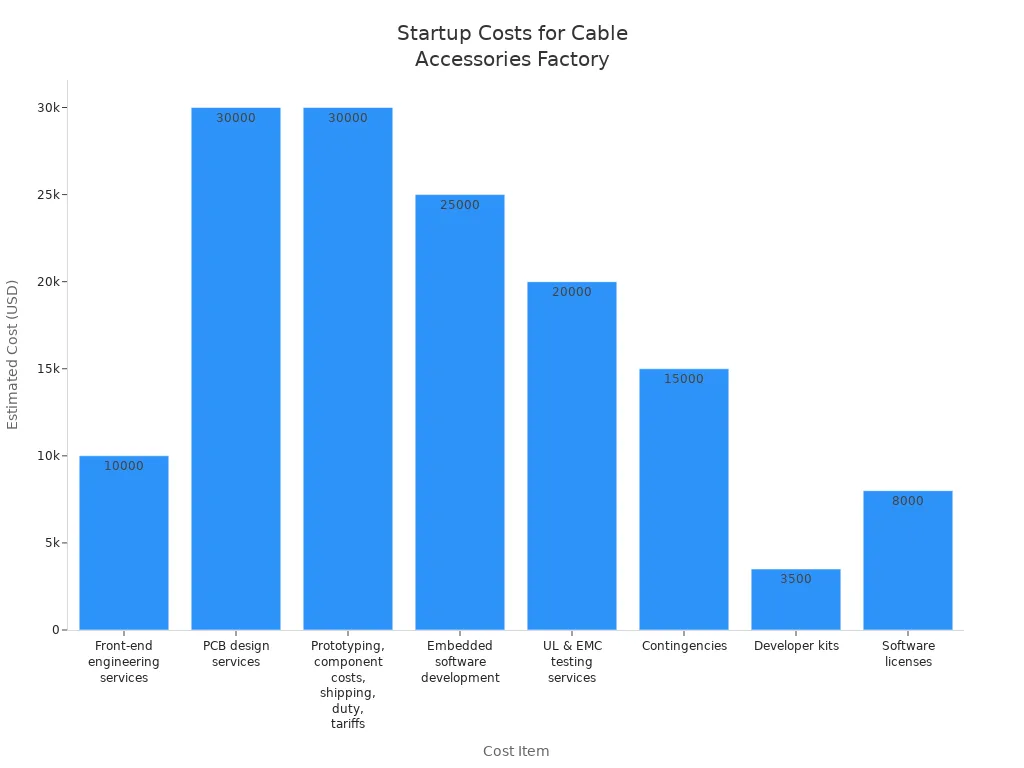
You need to make a clear budget for your cable accessories factory construction. Starting a factory costs a lot. You must think about engineering, design, prototyping, and testing. The table below shows average costs for starting a cable accessories factory:
Cost Item | Estimated Cost |
|---|---|
Front-end engineering services | $10,000 |
PCB design services | $30,000 |
Prototyping, component costs, shipping, duties, and tariffs | $30,000 |
Embedded software development services | $25,000 |
UL & EMC testing services | $20,000 |
Contingencies | $15,000 |
Developer kits | $3,500 |
Software licenses | $8,000 |
Total | $141,500 |
You can use your savings, get a bank loan, or ask investors for money. You should check your business plan often. This helps you set goals and plan your steps. You need to do market research and forecasting. This helps you guess your costs better. Look at your expenses closely. Check direct, fixed, variable, and overhead costs. This helps you control your budget and avoid problems.
Tip: Watch your budget closely. Small mistakes can turn into big issues later.
You need to pick a good place for your cable accessories factory construction. Find a spot near suppliers and customers. This saves money and time on shipping. You need enough room for machines, storage, and workers. Safety and efficiency are very important.
The table below shows best ways to design your factory layout:
Best Practice | Description |
|---|---|
Design for Manufacturability (DFM) | Find problems before making products. This makes your design strong. |
Connector Compatibility | Check fit and performance early. This stops mistakes later. |
Bend Radius and Routing | Keep minimum bend radii. This keeps cables safe and strong. |
Material Selection | Match wire insulation and shielding to the environment. This makes things safer and better. |
Standardization | Use common parts. This makes buying and checking quality easier. |
Documentation and Revision Control | Keep good records. This lowers mistakes and keeps things the same. |
Material Traceability | Track materials. This helps with rules and quick fixes if needed. |
Quality Standards | Follow standards like IPC/WHMA-A-620 and J-STD-001. This keeps work safe and good. |
You need to design your factory to handle cables safely. Make sure your layout lets people move and store things easily. Use good insulation for wires and cables. This keeps workers safe and protects products.
You must get the right licenses before you start cable accessories factory construction. Check local and national rules. You need to follow safety, environmental, and quality standards. Some important certifications and standards include:
UL 62275: This is the main safety standard for cable ties in North America. It covers strength, temperature, and flammability.
IEC 62275: This is used worldwide for cable accessories. It helps with international projects.
NEMA classifications: These match cable ties to different environments.
RoHS: This limits hazardous materials in electrical products.
REACH: This controls chemicals in manufacturing to protect health and the environment.
You must use good insulation materials to meet these standards. Good insulation keeps cables safe and helps your factory pass checks. You need to keep records of your materials and steps. This makes it easier to show you follow rules if someone checks.
Note: Meeting these standards keeps workers and customers safe. It also helps your cable accessories factory construction go well.
You must plan each step of cable accessories factory construction carefully. You need to get funding, pick a good place, and follow all rules. You must use safe insulation and keep cables neat. This helps your factory grow and do well.
You need the right materials to make cold shrink tubing. The main ones are elastomers like silicone, EPDM, and chloroprene. These materials make the tubing strong and bendy. They also help it stand up to heat, cold, and chemicals. You should buy these from trusted chemical suppliers around the world. This keeps your cold-shrinkable cable accessories safe and strong for many jobs. Good raw materials help your tubing last long and protect cables from harm.
A smart choice of materials gives you these good things:
High-quality silicone rubber stops tracking and rust.
The tubing works well with electricity and keeps cables safe.
Your accessories keep out water, dirt, and stress.
Feature | Description |
|---|---|
Raw Materials | Good raw materials like rubber or plastic mixes. |
Insulation & Sealing | Gives great insulation and sealing for power cables. |
Mechanical Protection | Protects against stress and things in the environment. |
Tip: Always make sure your suppliers follow strict quality rules. This helps you avoid trouble with your cold shrink tubing and cold-shrinkable cable accessories.
You should know how cold shrink tubing is different from heat shrink tubing. Cold shrink tubing does not need heat to go on. You just pull out the core, and it shrinks to fit the cable. This makes your job faster and safer. You do not need special tools or a heat gun. Cold-shrinkable cable accessories are good for places where you cannot use fire or heat.
Here is a table to help you see the differences:
Feature | Cold Shrink Tubing | Heat Shrink Tubing |
|---|---|---|
Installation Process | Fast and easy, no heat needed | Needs heat, takes longer |
Tools Needed | None | Needs a heat gun or torch |
Sealing Effectiveness | Very good, handles temperature changes | Depends on skill, might leave gaps |
Long-Term Reliability | Reliable, but chemicals can affect it | Changes, can get worse over time |
Cold shrink tubing saves time and lowers risks. You also get better sealing and fewer mistakes. This makes your cold-shrinkable cable accessories work better for many cables.
You should follow strict rules when making 3m cold shrink tubing. These rules help you make safe and high-quality cold-shrinkable cable accessories. 3m cold shrink tubing meets many world standards. These include IEEE, IEC, CENELEC, GB, and JCAA. Each one checks for safety, strength, and how well the tubing protects cables.
Standard | Description |
|---|---|
IEEE | Institute of Electrical and Electronics Engineers standards |
IEC | International Electrotechnical Commission standards |
CENELEC | European Committee for Electrotechnical Standardization standards |
GB | National standards of China |
JCAA | Japan Civil Aviation Association standards |
You need to test your 3m cold shrink tubing to make sure it passes these rules. This helps your cable accessories stay safe and ready to use in many countries.
Note: Meeting these rules helps your cold-shrinkable cable accessories work well in tough places and pass safety checks.
You must follow clear steps to make sure your cold shrink tubing and cold-shrinkable cable accessories work well. Here is an easy process you can use:
Get your work area ready. Make sure it is clean and you have your tools.
Strip the cable. Take off the outer layer and get the ends ready.
Clean and ground the cable. Make sure the grounding is tight.
Put on the cold shrink sleeves. Place the tubing right and secure it.
Handle the copper shielding and semiconductor layers. Make sure these are in the right spot.
You need to check your work at every step. Quality control is very important for cold shrink tubing and 3m cold shrink tubing. Here are some important checkpoints:
Step | QC Checkpoint | Pass Criteria |
|---|---|---|
1 | Stress cone positioning | Centered on semiconductor edge ±3 mm |
2 | Tube alignment | Lined up with the cable |
3 | Core removal initiation | Smooth, steady unwinding starts |
4 | Core removal completion | Core comes out with no tube damage |
5 | Interface inspection | No air gaps, wrinkles, or ridges |
You should also:
Check if the tubing fits the cable size.
Remove the core slowly so you do not twist the tubing.
Feel the tubing after to check for soft spots or gaps.
Always use good quality control. This keeps your cold-shrinkable cable accessories safe and helps your cables last longer.
You can build a strong process for making cold shrink tubing and 3m cold shrink tubing by using the right materials, following rules, and checking your work at every step. This helps you make cable accessories that protect cables and work well in many places.
You need workers who know how to use machines. They must also know how to handle materials. You need engineers and people to check quality. Training is important for everyone in the factory. You can teach workers at your factory or at a distributor’s place. If something goes wrong, your team can learn from it right away. Hands-on classes help your staff learn new skills. Some companies have special programs, like Medium Voltage Power Certification, to help workers do better.
Training Type | Description |
|---|---|
Installation Training | Flexible classes at your factory or distributor, with real-time problem solving. |
Certification Program | Medium Voltage Power Certification helps make the grid work better. |
Case Studies | Custom classes in different countries to help installers get better. |
You can also use programs to help workers keep learning. These programs teach about cable systems and accessories.
You must check every step when making cable accessories. Quality checks keep your products safe and strong. Test your raw materials, size, and strength. You should also test how your accessories work in real life. The table below shows important tests:
Testing Process | Purpose |
|---|---|
Raw Material Inspection | Check if materials are strong and can take heat. |
Dimensional Verification | Make sure sizes are right for the design. |
Mechanical Load Test | Pretend to pull on cables to see if they hold up. |
Electrical Continuity Test | Make sure the connections work well. |
Environmental Simulation | Test with sunlight, wet air, and rust. |
You should follow rules like ISO 9001 and UL Certification. These rules help you keep quality high and follow safety laws.
You must keep your factory safe for everyone. Electricity can be dangerous and hurt workers. Use good insulation and put clear labels on all machines. Teach your team to see dangers and follow safety steps. Mark places for vehicles and put guards on machines. Clean work areas stop slips and falls. Store chemicals in safe boxes. You should check cables and machines often. Use fire-resistant things and label everything. Show your staff what to do in emergencies.
Tip: Checking often and having clear safety rules keeps your team and products safe.
You need a good supply chain to get materials for your factory. Work with suppliers you trust who bring things on time. Track your shipments and keep good records. Store parts in an organized way so you can find them fast. Plan how to send products so customers get them quickly. Good planning helps your factory work well and keeps customers happy.
You can make a cold shrink cable accessories factory by following simple steps. First, learn about the market and make a plan. Next, get money and pick a safe place. Use good materials for your cable accessories. Teach your workers and check quality often. Always follow safety rules and industry standards. Take each step one at a time. Use what you learn to help you decide things. If you feel ready, you can start building your factory now.
You can install cold shrink cable joints quickly. They do not need heat. This makes your work safer and faster. You get a strong connection that lasts a long time.
You should use cable sealing systems designed for outdoor use. These systems help you create a waterproof cable seal. This keeps water and dust away from your cables during field installation.
You can use cold shrink insulation tubes in many places. They have a wide application range. You will find them in power plants, telecom towers, and even in home wiring projects.
Cable insulation keeps electricity inside the wires. It protects you from shocks. It also stops cables from touching each other. You need good insulation for every application to keep your system safe.
Cable sealing systems give you a tight seal. They protect cables from water, dust, and chemicals. You can use them in harsh environments. They work well for both new projects and repairs.